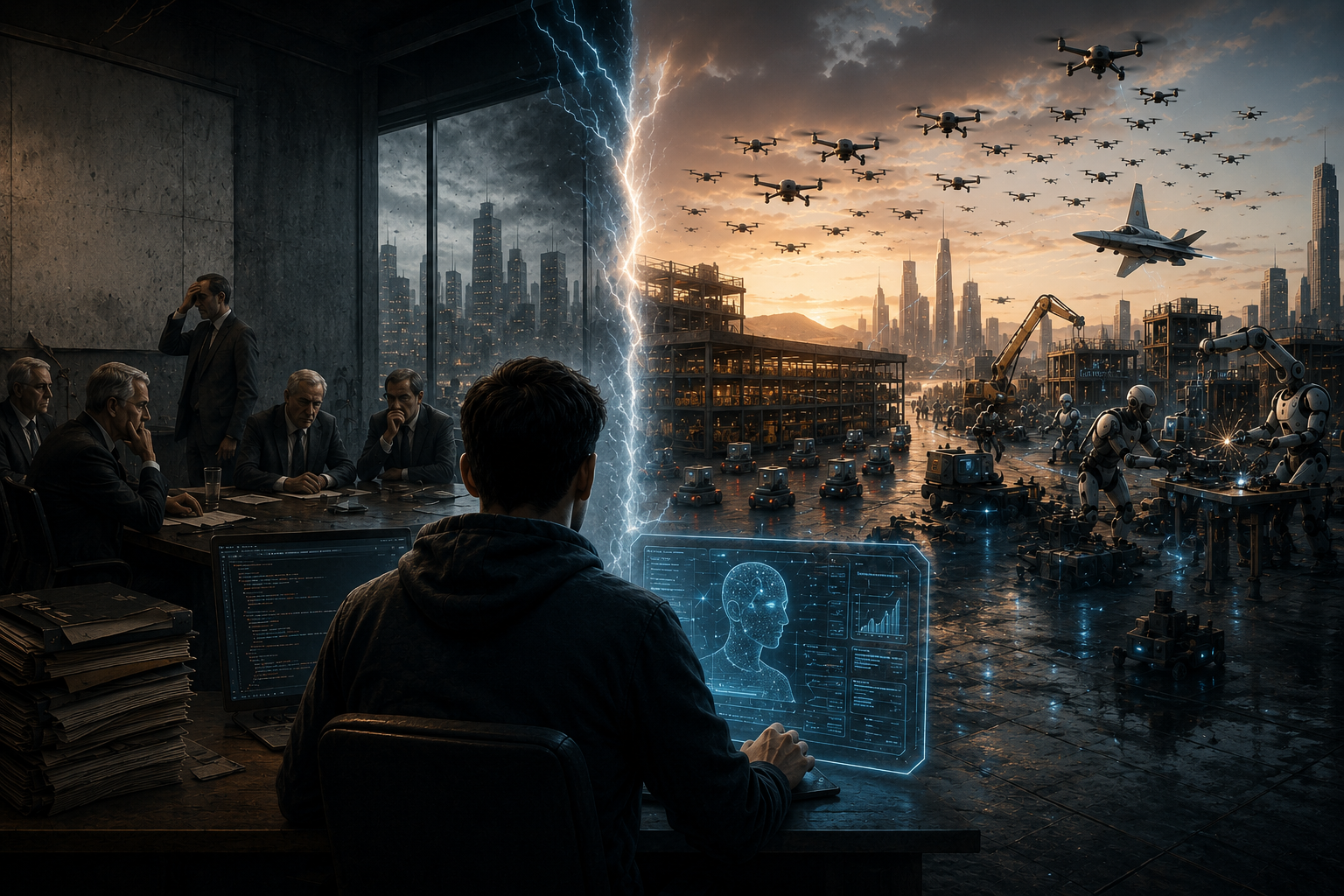
We are still debating whether a technological revolution will begin, while already standing inside it.
The cities are still standing. People live, study, walk, build, fight, grow. It seems like everything is the same as always. But the catastrophe has already begun — a catastrophe whose onset no one noticed, one that will affect hundreds of millions of people to varying degrees. The chance that the number will cross a billion is more than real. Humanity has never faced a cataclysm of this scale. And yet it seems like everything is the same as always.
One part of the familiar world has changed. And that part is the speed of change itself.
Today, a person at a computer is capable of what, just a couple of decades ago, belonged in science fiction. And not only in the virtual world, though for now it is still mostly there. But no longer only there. In reality. With hands. On the factory floor. On the proving ground.
A single warehouse operator doesn’t manage one forklift — they manage a squad. Not five machines in sequence, but a swarm that reroutes itself, avoids obstacles on its own, decides who goes where. The person doesn’t drive. The person conducts. On construction sites in Japan, China, and the UAE, brigades of robotic masons and robotic welders work in shifts — no smoke breaks, no sick leave, no union. One engineer with a tablet assigns the shift’s tasks and walks away to get coffee. In the military, things have gone further still. Swarms of drones — not ten, not fifty, but hundreds of machines advancing in coordinated attack — have ceased to be a lab demo. In Ukraine, operators control squads of FPV drones where one machine scouts, the second suppresses, the third finishes the job — all in real time, by a single person sitting in a dugout behind a laptop. The Pentagon is launching the Replicator program — thousands of autonomous systems to be deployed not in a decade, but now. China displays swarms of hundreds of drones at parades, controlled by a single algorithm and a single observer-operator. A fighter pilot in a next-generation cockpit is no longer alone — beside them flies a “loyal wingman,” a drone making decisions at a level that, just yesterday, was available only to a second human pilot.
The role of one person is changing radically. But not one person alone. A pairing. Human plus AI.
This is no longer “a person uses a tool.” A hammer doesn’t argue with you, doesn’t suggest alternatives, doesn’t say “what if we tried it this way?” The human–AI pairing is a duo where one sets the task and makes the decision, and the other executes, searches, calculates, generates, verifies — at a speed physically impossible for any team of twenty, fifty, a hundred people. A single developer with an AI assistant writes, tests, and ships a product that three years ago required an entire department. A single translator with AI handles a volume that once demanded a bureau of fifteen. A single designer generates in one evening as many branding variants as a studio used to produce in a month. A single analyst processes a document set that once took a team a full week.
And this is not “assistance.” This is not “automating routine.” This is a change in the unit of measurement. Before, the unit was a department. Now the unit is a pairing. One person and a model. And those who understood this gain such acceleration that, for them, competitors moving the old way fall behind by days, weeks, months. Not by percentages. By orders of magnitude.
The speed of the gap is accelerating. What was recently fully profitable now doesn’t even break even. But those using old, proven technologies haven’t realized it yet. They see that revenue dipped slightly. That a competitor appeared — strange, small, no office, no staff, no clear structure. They say: let’s wait, the market will correct, this is temporary.
And here is the question no one wants to ask at the board meeting.
You have money. You have a brand built over fifteen years. You have contracts, connections, a clear model: invest — receive profit by quarter. You operate on inertia, because inertia worked for twenty straight years. You expect the next report. The next dividend payout. The next cycle.
But do you really still have that quarter?
Do you really still have that money — or has it already been devalued, not by inflation, but by the fact that your service, your product, your expertise are now worth zero, because one person in a rented apartment, with a two-hundred-dollar monthly subscription and a model that thinks faster than your department, did the same thing over the weekend. Better. Cheaper. Without your Monday meeting.
Your firm wasn’t killed by a competitor. Your firm was displaced by one person. And they didn’t even notice they displaced it. For them, it was just a Tuesday.
The flash has already happened. The light is different now. The shadows have shifted. And you’re still looking at the old shadows, wondering why they don’t line up.
Leave a Reply